Metal Roofing Gauge: How to Read the Panel Spec
Gauge is a sheet-metal thickness label. For comparable steel sheets, a lower gauge number generally means thicker metal. That label alone does not tell you which panel belongs on your roof.
Read gauge with the metal type, actual thickness information, panel shape, and installation requirements. You can use those details to compare descriptions and catch a mismatched order. Choosing a roof's structural specification requires more than a thickness label.
Separate the label from the measurement
A gauge number is not a thickness written in inches. It refers to a thickness convention. Gauge tables can differ by metal type and by how the product thickness is described. Do not take a generic internet table as the exact specification of a named panel.
Base metal thickness means the thickness of the metal beneath its coatings. Coated thickness includes material on that metal. Paint and metallic coatings are not the same thing as the steel beneath them.
A product sheet may give a nominal thickness, a named target value, or a minimum thickness, its stated lower limit. Read the label attached to the measurement. If the page gives a number without saying what it includes, ask for clarification.
Do not silently compare a coated measurement with an uncoated specification. Keep them in separate rows of your notes. A difference between them is not automatically evidence of a wrong sheet.
Decode a panel description line by line
Imagine a hypothetical description that reads: steel PBR panel, 26 gauge, painted finish, roof use. Each part answers a different question. It does not answer every question about fit or fastening.
Steel identifies the metal. PBR identifies a panel family. Profile means the sheet's end shape, including its raised ribs and bent edges. The gauge label describes thickness. Painted finish describes the surface. Roof use identifies an intended application.
Now look for the missing details: exact profile drawing, base thickness information, coating description, cut length, coverage width, and installation guide. Coverage width is the width a sheet covers after its side joint overlaps the next sheet.
Do not assume the width printed on a receipt is coverage width. Ask what that field means. Do not assume a shared gauge number makes two panel profiles interchangeable either. Their edge shapes still need to match.
Use this specification decoder
Copy the table for the existing panel and each candidate. Mark information not found as unknown. That is more useful than filling gaps from memory.
| Field | What it means | What to compare |
|---|---|---|
| Metal type | Material beneath the finish | Same type or a separately checked change |
| Gauge | Thickness label | Exact label on the product record |
| Base thickness | Metal without coatings | Stated value and whether nominal or minimum |
| Coated thickness | Measurement including coatings | What coatings the value includes |
| Profile | Cross-section and edge bends | Full end drawing, not just the tallest rib |
| Coating | Surface system on the metal | Exact finish description, not color alone |
| Intended use | Application covered by the guide | Roof or wall section matching your job |
| Roof requirements | How the panel is used on this building | Building drawings and panel instructions |
The decoder is an ordering aid. It does not turn a collection of labels into a strength calculation.
Check an existing sheet without damaging it
- Search the paperwork first. Look at old receipts, packing labels, spare-sheet tags, and building records. Photograph the full description so you retain neighboring fields.
- Find the exact product sheet. Search the panel maker's downloads for its profile name. Compare the end drawing with an undamaged spare piece before assuming the sheet matches.
- Record a loose sample if available. Photograph both faces and the cut end. Use gloves. Do not cut a sample from the installed roof just to identify gauge.
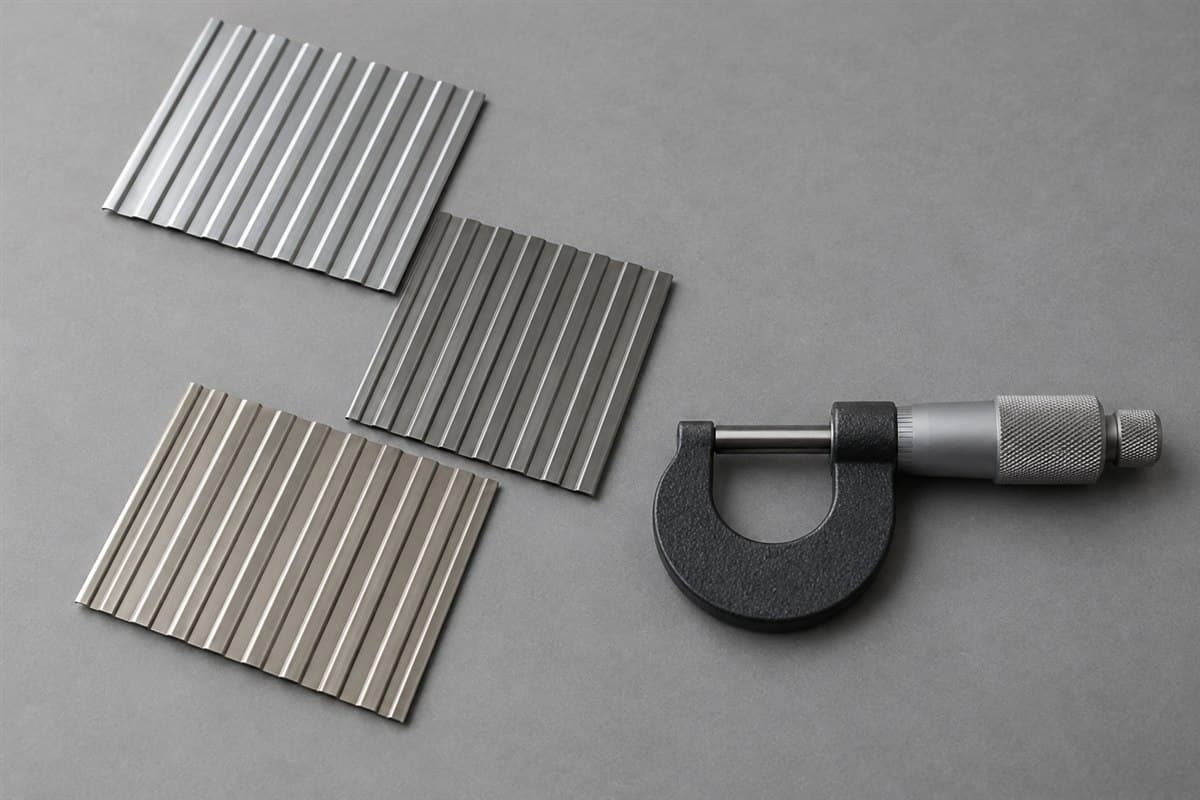
- Measure only if it helps the question. A micrometer is a measuring tool with jaws designed for small thicknesses. Follow its instructions, clean the contact faces, and check that it reads zero when closed.
- Choose an intact flat area. Avoid a folded edge, burr, rust spot, or crushed rib. Repeat at several clean places on the loose sample. Record that your reading includes the coatings still present.
- Compare like descriptions. Send the sample readings and photos with the old record. Ask whether a measurement should be professionally checked before choosing a replacement.
A household reading cannot establish the original base thickness through damaged or weathered coatings. Do not scrape off the finish to force agreement with a gauge table.
Choose the panel before treating gauge as the answer
Ask what profile and thickness the building needs, then compare candidates that meet that requirement. Panel shape, support arrangement, material properties, and fasteners all belong to the roof system. Changing one label does not prove the complete system still works.
Take spans, loads, fastening patterns, overlaps, and any strength-related thickness choice from the building's drawings or panel maker's installation instructions. If the old barn has no drawings, an engineer can investigate the roof. Do not choose a gauge by another owner's recommendation alone.
The catalog lists 26-gauge PBR panel and 26-gauge R-panel as 26-gauge panels. Treat that as a catalog label to compare, not a recommendation for every roof. Their actual documentation must establish the details needed for your job.
For old-to-new shape checks, read How to Match Old Metal Roof Panels. For final length and coverage planning, use How to measure and order metal panels by length. Keep those decisions separate from thickness identification.
The common mistakes are simple: using one gauge chart for every metal, measuring through a folded edge, and treating thicker as automatic permission to change support spacing. A complete comparison names the exact sheet and explains every thickness field. That is the useful result to bring to the next decision.