Metal Roof Screws for Wood vs Steel: How to Choose
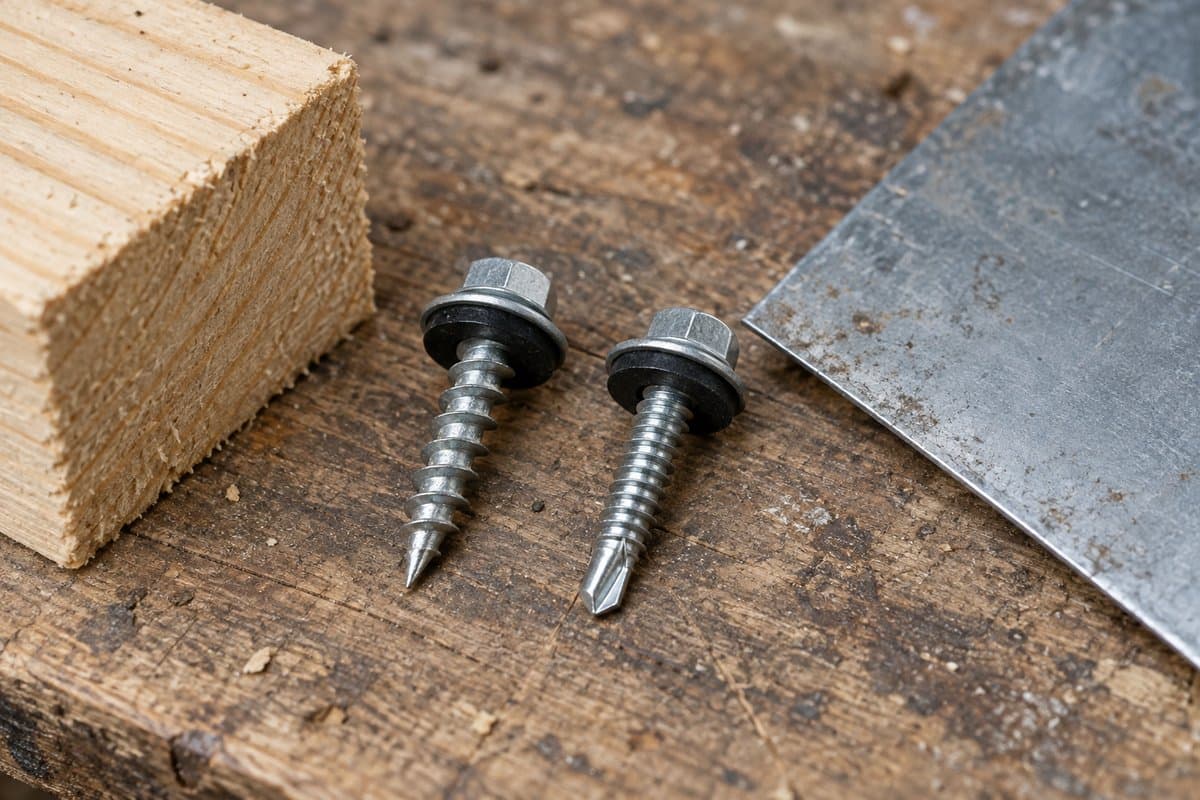
Look below the panel, not just at the panel itself. The screw needs to grip the receiving support. A steel roof panel can sit on wood framing, steel framing, or a layered assembly. Those situations need different checks.
Wood fasteners commonly have a sharp point and more widely spaced threads. Metal-to-metal fasteners commonly have a drill-shaped point. These are identification clues. Select the actual part using its stated application and your panel's instructions.
You do not need original barn drawings to identify visible wood or steel. You do need more than the word steel to settle a screw's drill point and length.
Locate the material the threads actually grip
The substrate is the receiving material below the panel. A purlin is a roof framing member that supports the panels. Panels may instead sit over decking, a continuous layer of boards or sheet material.
From a safe interior position, look at the underside of the roof. Locate a panel screw line and the support directly beneath it. Do not assume a timber elsewhere in the building is the receiving support at that location.
Photograph the support and the roof section together. Keep different sections separate. If an addition uses different framing, give it a separate note before making the parts list.
For roof work, use suitable fall protection and hire a roofer if you cannot inspect safely.
Collect the missing support facts
Use a flashlight, camera, notebook, ruler, and any spare material labels. A caliper, a tool with measuring jaws, can help identify an accessible loose steel sample. Do not remove or drill a support to obtain a measurement.
- Name the connection. Write panel to support or sheet to sheet. A stitch screw joins overlapping thin sheets; it is a separate fastening role.
- Identify the receiving material. Write solid wood, sheet wood decking, steel, or unclear. Take a view that shows why you chose that description.
- List the layers. Record visible panel layers and any layer between panel and support. Insulation means a layer used to reduce heat transfer. Do not compress it to guess the screw length.
- Find steel thickness information. Check spare-member labels or an accessible exposed edge. Record an actual identification measurement only if it can be taken safely without disturbing framing.
- Record support condition. Note visible wood splitting, decay, rust, or damaged metal. A new screw selection cannot settle a damaged-support repair.
- Identify the panel. Find the profile name and its roof installation guide. Search old receipts or wrapping, then look on the maker's technical or downloads page.
- Compare the specified screw family. Read the guide's panel-to-support fastening section. Check it against the fastener technical sheet for receiving material and permitted thickness.
If the screw disappears into a hidden layer, mark that layer unknown. A photograph cannot establish the thickness behind the surface. Have a roofer inspect concealed conditions before choosing a replacement on a guess.
Copy this support request card
Use the card when a technical sheet is missing or a candidate's use is unclear. It asks for enough information to filter parts without asking someone to guess from a roof photo.
Building section: Name the barn roof, shop roof, or addition you are checking.
Connection job: State whether the screw joins a panel to a support or joins thin sheets.
Panel: Give the profile name and thickness designation if known. Attach a label or an end-view photograph.
Receiving support: Describe wood, wood decking, or steel. Attach an underside view showing the relevant screw line.
Support identification: Add steel thickness information, wood material information, and where those facts came from. Write unknown where necessary.
Intervening layers: List each visible layer in order from panel toward support. Describe any hidden layer as hidden.
Existing screw: Attach the complete label and loose-sample photos if available. Keep them identified as existing, not automatically correct.
Question to resolve: Ask whether the candidate's stated application matches this assembly, and request the missing technical sheet.
This is an identification card. It does not choose a drill-point number, penetration depth, or fastening pattern.
Read the candidate's technical sheet in order
Begin with its receiving-material description. Then read the material-thickness limits for steel use. Drill capacity means the material range the point is designed to drill. It is a fastener specification, not something you can infer from a photograph.
Next compare the point, thread, stated length, and sealing washer. A sealing washer is the flexible seal beneath an exposed roof-screw head. Confirm the washer and screw material are suitable for the panel's stated use.
Your building's drawings or the panel maker's installation instructions decide required penetration, fastening patterns, support requirements, and driving torque. If there are no building drawings, start with the identified panel's guide. Get help for framing damage or an assembly that the guide does not cover.
Use How to Read Metal Roof Screw Sizes to decode the size fields. Use Self-Drilling vs Self-Tapping: How to Tell Them Apart if the tip terminology is confusing.
Choose only from confirmed details
The listed Self-drilling roof screws with sealing washer, #12 x 1-1/2 in is a pending self-drilling roof screw with a sealing washer. That description does not establish its drill capacity or suitability for a particular wood connection. The catalog does not list a separate wood-grip roof screw.
If the job requires a type absent from the catalog, keep that need on your list. Do not relabel a listed metal fastener to fill the gap.
Avoid choosing by color, using a lap screw as a support screw, or extending a screw because the layers look thick. Complete the support card first. Then use How to count screws and closures for a metal roof for quantities based on the required pattern.