Metal Roof Trim Names: How to Identify Each Edge
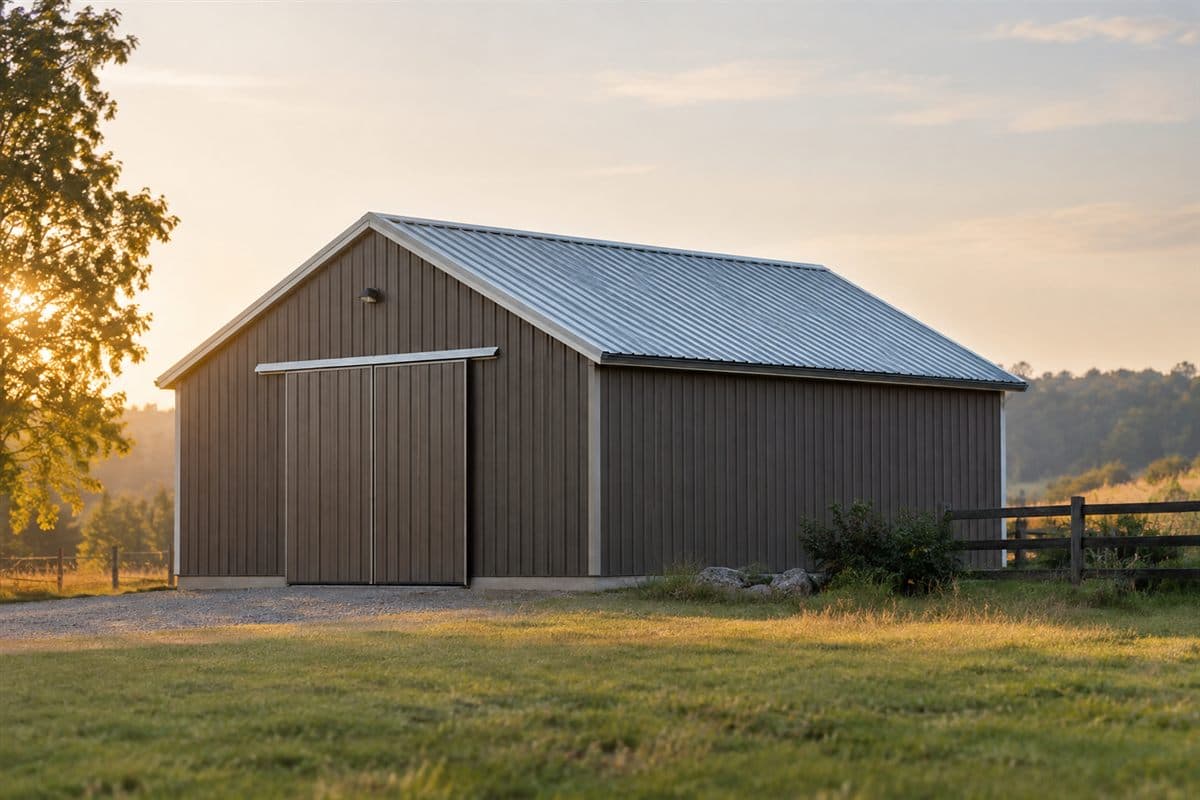
Name roof trim by where it sits. The lower edge uses eave trim, the sloping end edge uses rake trim, and the roof peak uses ridge cap. Start with a ground view, then compare the actual bends before choosing a replacement.
Trim is formed metal covering an edge or junction. Flashing is formed metal directing water at a junction. The terms can overlap. A location name starts the search, but it does not describe every bend in the piece.
Read the roof outline from the ground
An eave is the lower roof edge. On a simple peaked roof, water runs down the slope toward this edge. Look along the building's side to see it.
A rake is the sloping edge at the end of that roof. From a ground view facing the building end, the two sloping outline edges are the rakes.
The ridge is the high line where the two roof slopes meet. A ridge cap covers that meeting line. Follow it along the peak rather than confusing it with a sloping end edge.
Walk to a safe side view if the first photo hides an edge. Keep the whole building in a wide photo. You can crop a closer view later without losing the location.
For roof work, use suitable fall protection and hire a roofer if a closer inspection requires unsafe access.
Fill in the roof-location chart
Use this chart with photos of your own roof. It identifies locations without assuming the building has drawings.
| Location | Name to look for | What distinguishes it | Your photo or note |
|---|---|---|---|
| Lower edge of roof slope | Eave trim | Bottom edge above the building side | Mark the roof section |
| Sloping outline at roof end | Rake trim | Edge rises toward the peak | Mark which end and side |
| High line between two slopes | Ridge cap | Covers the roof meeting line | Show the length of the peak |
| Roof meeting a wall | Roof-to-wall flashing | Metal joins a roof and vertical wall | Name the wall and roof section |
| Roof changing slope | Slope-transition flashing | One slope meets another angle | Show both roof planes |
| Inward meeting of slopes | Valley flashing | Slopes meet at an inward junction | Show the junction clearly |
A valley is an inward junction between roof slopes. A transition is a change in slope or arrangement. These rows prevent you from calling every bent piece eave, rake, or ridge trim.
The chart does not mean every named flashing is offered in the catalog. In particular, a generic slope transition should not be matched to a product just because transition appears in its name.
Identify the piece and compare its bends
- Pick one edge. Name its roof section and mark it on a sketch. Use a fresh note when you move to another edge.
- Take a location photo. Show enough roof to distinguish the lower edge from the sloping end. Keep a recognizable building corner in view.
- Find shape information. Use a loose spare, an intact sample already removed, or a product drawing. Do not pull sound trim off the roof just to obtain a sample.
- Draw the bends. View the loose piece from its end. Mark each flat face, folded lip, and return. A leg is one flat face of a bent trim piece. A return is an edge folded back toward the metal.
- Measure the loose part. Measure its length and each flat leg. Mark the endpoints on the sketch and write units. Use intact bends rather than crushed areas.
- Compare the candidate. Check its end drawing against your sketch. Look at how its legs meet the roof, wall, and adjoining metal.
- List the remaining fields. Record finish, thickness designation, length, and quantity. Keep different shapes and lengths on separate lines.
Use gloves, ruler, tape measure, pencil, notebook, and camera at a bench. If a piece is damaged beyond recognition, photograph a sound neighboring example where access is safe.
Find a guide without original drawings
Search spare-panel wrapping, receipts, or repair notes for the panel maker and profile. On the maker's website, look for the exact profile's installation guide. Find the page for the edge you are identifying.
A detail is a close-up drawing of that junction. It shows how the trim relates to the panel and neighboring parts. Use it to understand which bends you are seeing on the loose sample.
If the barn has no papers, your location photo and end sketch are still useful. Send them together when asking for a matching shape. A message saying edge trim leaves too much room for confusion.
Do not choose from a distant photo alone when the bends are hidden. Ask a roofer to collect the missing view if that requires roof access.
Compare the listed roof-edge candidates
For a simple roof, the relevant listings are Eave trim, Rake trim, and Standard-pitch ridge cap. These entries await confirmation. Use them to compare the needed part information rather than assuming immediate availability.
A ridge cap also needs the roof's pitch, meaning its steepness. A cap must suit the meeting angle of the slopes. Use reliable roof information or have that angle measured safely. Do not guess it from a tilted ground photo.
Your building's drawings or the panel maker's installation instructions decide trim overlaps, fastening patterns, and strength-related dimensions. The location chart gives no installation numbers.
Name adjoining accessories separately
A closure is a shaped strip filling panel-profile gaps. If the edge or ridge needs one, identify its profile and orientation separately from the trim.
Use Inside vs Outside Foam Closures: Which Do You Need? for the shape comparison. If the joint needs tape, use How to Use Butyl Tape on a Metal Roof. Do not assume those accessories arrive with a trim piece.
Keep wall trim on a separate list. What trim pieces does a metal building wall need? covers that task. This chart stays focused on roof locations.
Make the identification useful for ordering
Before finishing, check that each piece has a location photo, shape sketch, measurements, and name. Keep uncertain bends marked uncertain. A damaged sample should not become an exact pattern by accident.
Avoid calling every roof-edge piece ridge cap or swapping eave and rake after changing viewpoints. The finished note should let another person locate the piece and compare its shape without guessing from a name.